
Surface Finishing for CNC Machined Parts: Options and Benefits
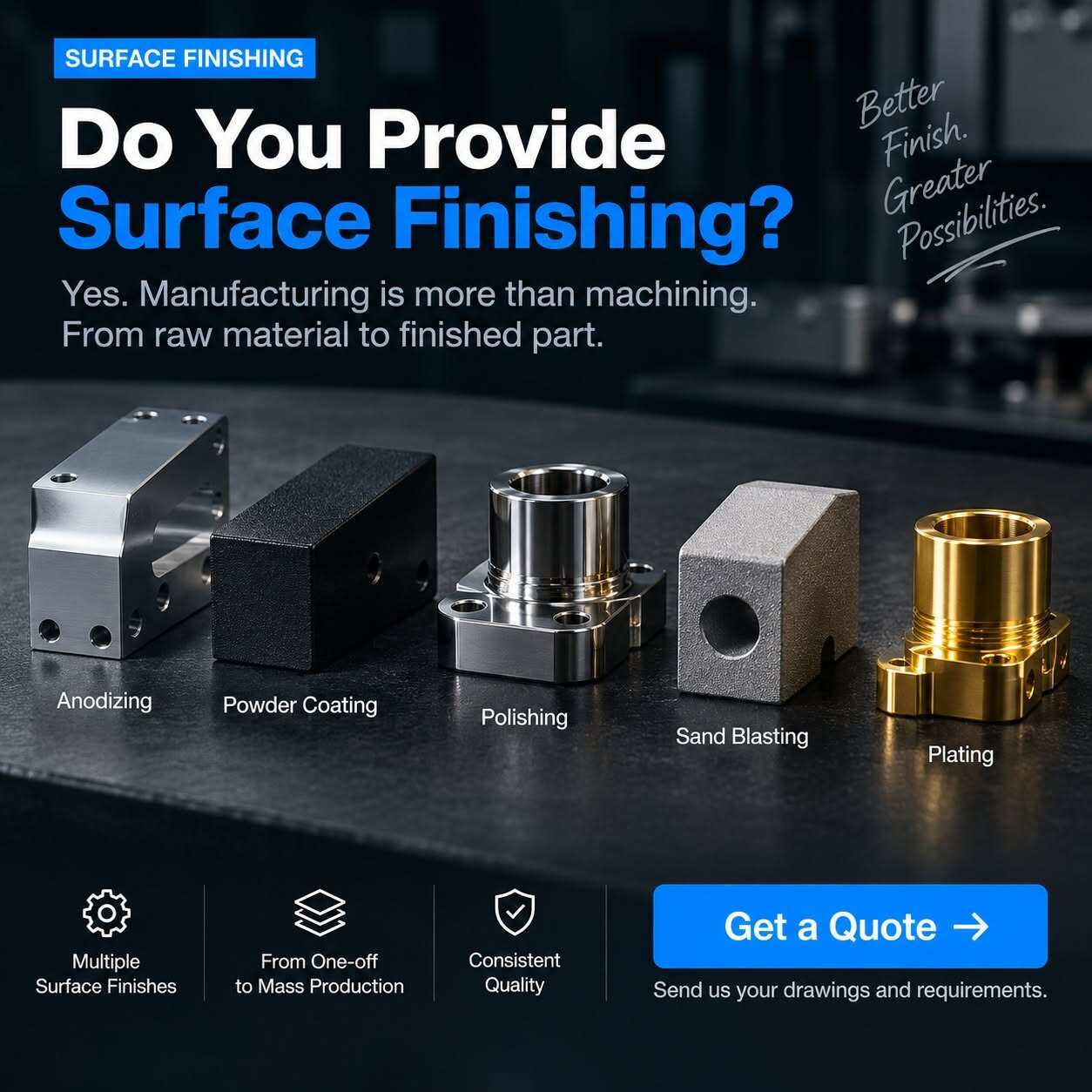
Surface finishing plays an important role in the performance, durability, and appearance of manufactured parts. From anodizing and powder coating to polishing and plating, choosing the right finish depends on the material, application, and functional requirements. Bafang Hardware supports surface finishing as part of an integrated manufacturing solution, from machining to final delivery.
What Is Surface Finishing?
Surface finishing refers to processes applied to a part's surface after machining or fabrication to achieve specific functional or aesthetic results.
Depending on the process and application, surface finishing can improve corrosion resistance, wear resistance, appearance, and surface texture. It can also help parts meet specific product requirements.
For CNC machined components, surface finishing is often an important step in preparing parts for assembly, testing, or end use. The appropriate process depends on the base material, operating environment, dimensional requirements, and intended application.
Common Surface Finishing Options
Different applications require different finishing solutions. The following are six common options for metal components and manufactured parts.
1. Anodizing
Anodizing is commonly used for aluminum components. It creates a controlled oxide layer on the surface, which can improve corrosion resistance and provide a decorative finish.
Depending on the anodizing type and specification, it can also support wear resistance and offer different color options.
Typical applications: Aluminum housings, brackets, enclosures, and precision machined components.
2. Powder Coating
Powder coating applies a dry powder to a part, which is then cured to form a continuous coating.
It provides a range of color and texture options and can offer good protection against corrosion, scratches, and environmental exposure when the coating system is properly selected.
Typical applications: Equipment housings, metal enclosures, brackets, and structural components.
3. Painting
Painting applies a liquid coating to a prepared surface. It offers flexibility in color, appearance, and coating specifications.
The final performance depends on factors such as surface preparation, coating selection, application method, and curing conditions.
Typical applications: Sheet metal parts, equipment panels, housings, and custom metal components.
4. Sand Blasting
Sand blasting, commonly referred to as abrasive blasting, uses abrasive media to clean or modify a surface.
It can remove certain surface contaminants, create a more uniform texture, and prepare parts for subsequent finishing processes. The resulting appearance depends on the abrasive media and processing parameters.
Typical applications: Metal parts requiring surface preparation, a matte appearance, or a consistent textured finish.
5. Polishing
Polishing reduces surface irregularities to achieve a smoother, more refined appearance.
Depending on the material and process, polishing can improve surface smoothness and visual quality. Where specific roughness requirements apply, the target should be clearly defined and verified.
Typical applications: Stainless steel components, visible machined parts, and components requiring a smooth surface.
6. Plating
Plating deposits a layer of another material onto a component's surface through an appropriate plating process.
Depending on the coating material and specification, plating can improve corrosion resistance, wear performance, electrical properties, or appearance.
Typical applications: Fasteners, mechanical components, electrical parts, and metal components requiring specific surface properties.
How to Choose the Right Surface Finish
The best surface finish is not necessarily the most expensive or visually attractive option. It is the one that meets the part's actual requirements.
Consider these factors when selecting a finishing process:
Base material: Different materials are compatible with different finishing processes.
Functional requirements: Consider corrosion resistance, wear, friction, electrical conductivity, and other operating conditions.
Appearance: Determine the required color, gloss level, texture, and visual consistency.
Dimensional tolerances: Coatings and surface treatments may affect critical dimensions, fits, holes, and threads.
Cost and production volume: The process should suit both prototype quantities and planned production volumes.
Inspection requirements: Define any required coating thickness, surface roughness, adhesion, or other acceptance criteria.
For parts with tight tolerances, critical threads, or precision mating surfaces, finishing requirements should be considered during the design and machining stages rather than added at the end.
Why Combine Machining and Surface Finishing?
Managing machining and surface finishing through multiple suppliers can increase coordination work and make quality control more complicated.
An integrated manufacturing approach helps align machining requirements, finishing specifications, inspection, and delivery planning.
At Bafang Hardware, we support projects involving CNC machining, sheet metal fabrication, injection molding, die casting, surface finishing, and assembly.
Depending on the project requirements, customers can coordinate multiple manufacturing processes through one partner instead of managing each process independently.
From prototype development to production, early communication about materials, tolerances, finishes, and quantities helps establish a more practical manufacturing plan.
Get a Quote for Your Parts
Need CNC machined parts with a specified surface finish?
Share your drawings, material requirements, finishing specifications, and estimated quantity with Bafang Hardware. Our team can review your requirements and assess suitable manufacturing and finishing options.
If you are unsure which finish is appropriate, let us know the part's intended application and operating environment.
Contact Bafang Hardware to discuss your project and request a quote.
Want this reviewed on your own part?
Upload your CAD file for a free DFM review. Our engineering team will assess manufacturability, material and process options, and cost drivers for your design.
Get a Free DFM Review