
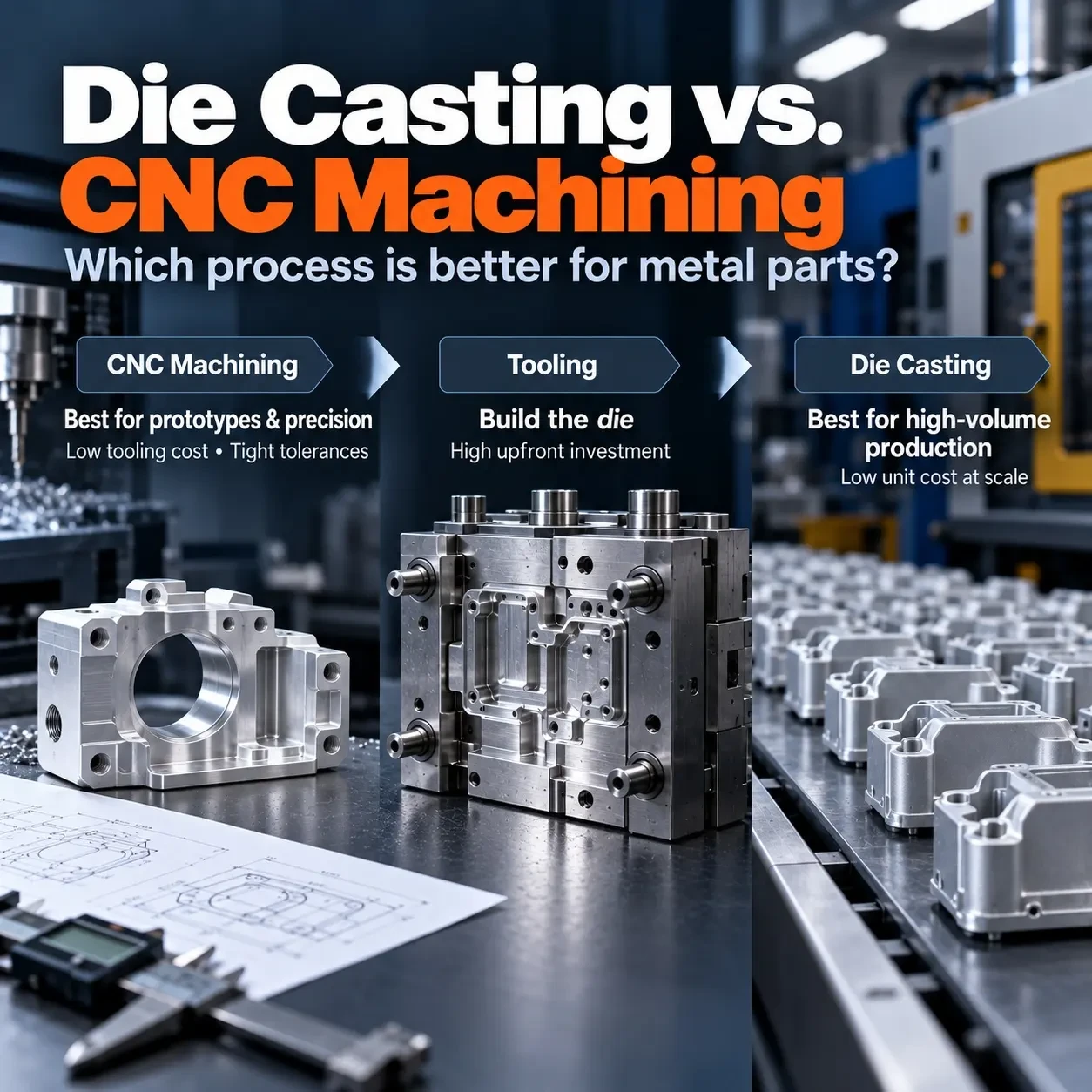
Guide 28: Die Casting vs. CNC Machining: Which Process Is Better for Metal Parts?
This guide provides an engineering-focused comparison between CNC machining and die casting for metal components. It evaluates both processes based on initial tooling costs, production volume economics, dimensional precision, material performance, and lead times. Additionally, it highlights the popular hybrid approach—combining die casting for near-net shapes with secondary CNC machining for critical features—to help engineers and product managers choose the optimal manufacturing strategy.
Guide 28: Die Casting vs. CNC Machining: Which Process Is Better for Metal Parts?
Cost, Precision, Volume & Material Performance | Manufacturing Academy
When designing a metal component, one of the first manufacturing decisions is choosing how the part will be made. Two of the most common options are CNC machining and die casting.
Both processes are widely used across industries such as automotive, electronics, robotics, industrial equipment, consumer products, and medical devices. However, they solve very different manufacturing problems.
Choosing the wrong process can lead to unnecessary tooling costs, long lead times, excessive machining, or parts that fail to meet mechanical expectations.
This guide compares CNC machining and die casting from an engineering perspective, helping you decide which process best fits your project.
1. What Is CNC Machining?
CNC machining removes material from a solid metal block (billet or plate) using computer-controlled cutting tools.
Common materials include: Aluminum, Stainless Steel, Carbon Steel, Brass, Copper, Titanium, and Engineering Plastics.
Because the part is cut directly from wrought stock, CNC machining offers excellent dimensional accuracy, material integrity, and design flexibility without dedicated tooling.
2. What Is Die Casting?
Die casting injects molten metal into a hardened steel mold (die) under very high pressure.
Once the metal solidifies, the mold opens and ejects the finished part.
Common die casting alloys include: Aluminum alloys (e.g., A380, ADC12), Zinc alloys (Zamak), and Magnesium alloys.
3. CNC Machining vs. Die Casting Comparison
Factor | CNC Machining | Die Casting |
Initial Tooling Cost | Very Low / None | Very High ($10k–$50k+) |
Part Cost (Low Volume) | Low to Moderate | Prohibitively High |
Part Cost (High Volume) | Higher | Very Low |
Lead Time | Days | Several weeks (tooling lead time) |
Material Options | Very Wide (Wrought metals & plastics) | Limited Casting Alloys (Al, Zn, Mg) |
Dimensional Accuracy | Excellent (±0.01 mm) | Good (±0.1 mm) |
Surface Finish | Excellent | Good (as-cast) |
Design Changes | Easy & Fast | Expensive & Slow |
Mechanical Strength | Superior (wrought grain structure) | Good (potential minor porosity) |
Production Speed | Moderate | Extremely Fast |
4. In-Depth Technical Comparison
Tooling Cost & Startup Lead Time
CNC Machining: Requires no hard tooling. Setup consists of CAM programming, workholding fixture design, and cutting tool selection. Production can begin in days.
Die Casting: Requires designing and machining hardened steel dies capable of withstanding extreme temperature and pressure. Tooling costs typically range from $10,000 to over $50,000, requiring 4–8 weeks before initial parts are cast.
Production Volume Economics
CNC Machining: Ideal for 1 to 500 parts, functional prototypes, and custom components where high tooling investment cannot be amortized.
Die Casting: Highly economical for thousands to millions of identical components. Once tooling costs are amortized, the unit cost is dramatically lower than CNC machining.
Precision and Tolerances
CNC Machining: Delivers tight tolerances (down to ±0.01 mm / ±0.0005 in). Ideal for precision bearing seats, sealing surfaces, and critical mating dimensions.
Die Casting: Typical as-cast tolerances are around ±0.1 mm to ±0.2 mm. Metal shrinkage, thermal expansion, and mold wear cause variations. As a result, critical sealing faces, threads, and bearing bores are frequently post-machined using CNC.
Mechanical Properties & Material Integrity
Because CNC components are machined from wrought extrusions or forged billets, they feature dense, consistent grain structure with higher tensile strength and fatigue resistance.
Die-cast components can suffer from internal gas entrapment, porosity, or shrinkage voids, which slightly lowers maximum tensile strength compared to wrought alloys.
5. Hybrid Manufacturing: Die Casting + Secondary CNC Machining
For high-volume structural metal parts, the industry standard solution is a hybrid workflow:
· Die Cast the near-net shape (thin walls, complex ribs, external contours).
· Secondary CNC Machining on precise features (bearing pockets, threads, critical mating faces).
· Surface Treatment (Anodizing, Powder Coating, E-coating).
This hybrid approach achieves the low unit cost of casting along with the high precision of CNC machining.
6. Which Process Should You Choose?
Choose CNC Machining if:
· You need 1 to 1,000 components.
· The design requires extremely tight tolerances (e.g. ±0.01 mm).
· The product is in active design iterations.
· You require high-strength wrought materials like 7075-T6 aluminum or stainless steel.
Choose Die Casting if:
· You require 5,000+ identical metal parts annually.
· The component features thin walls and complex integrated exterior shapes.
· Unit price is the primary driver and the design is frozen.
7. Conclusion & Key Takeaways
There is no single "winner" between die casting and CNC machining. For early product development and precision parts, CNC machining offers speed and accuracy. For high-volume mass production, die casting provides unmatched efficiency. Combining both processes often delivers the ultimate balance of cost and performance.
Ready to Find the Best Manufacturing Method for Your Metal Parts?
Choosing between CNC machining and die casting depends on your target volume, design flexibility, tolerances, and budget. Whether you need rapid CNC prototypes or high-volume die-cast production, our engineering team is here to help you optimize your design and select the most cost-effective solution. Contact us today for a free CAD review, DFM feedback, and customized quote!
Want this reviewed on your own part?
Upload your CAD file for a free DFM review. Our engineering team will assess manufacturability, material and process options, and cost drivers for your design.
Get a Free DFM Review