
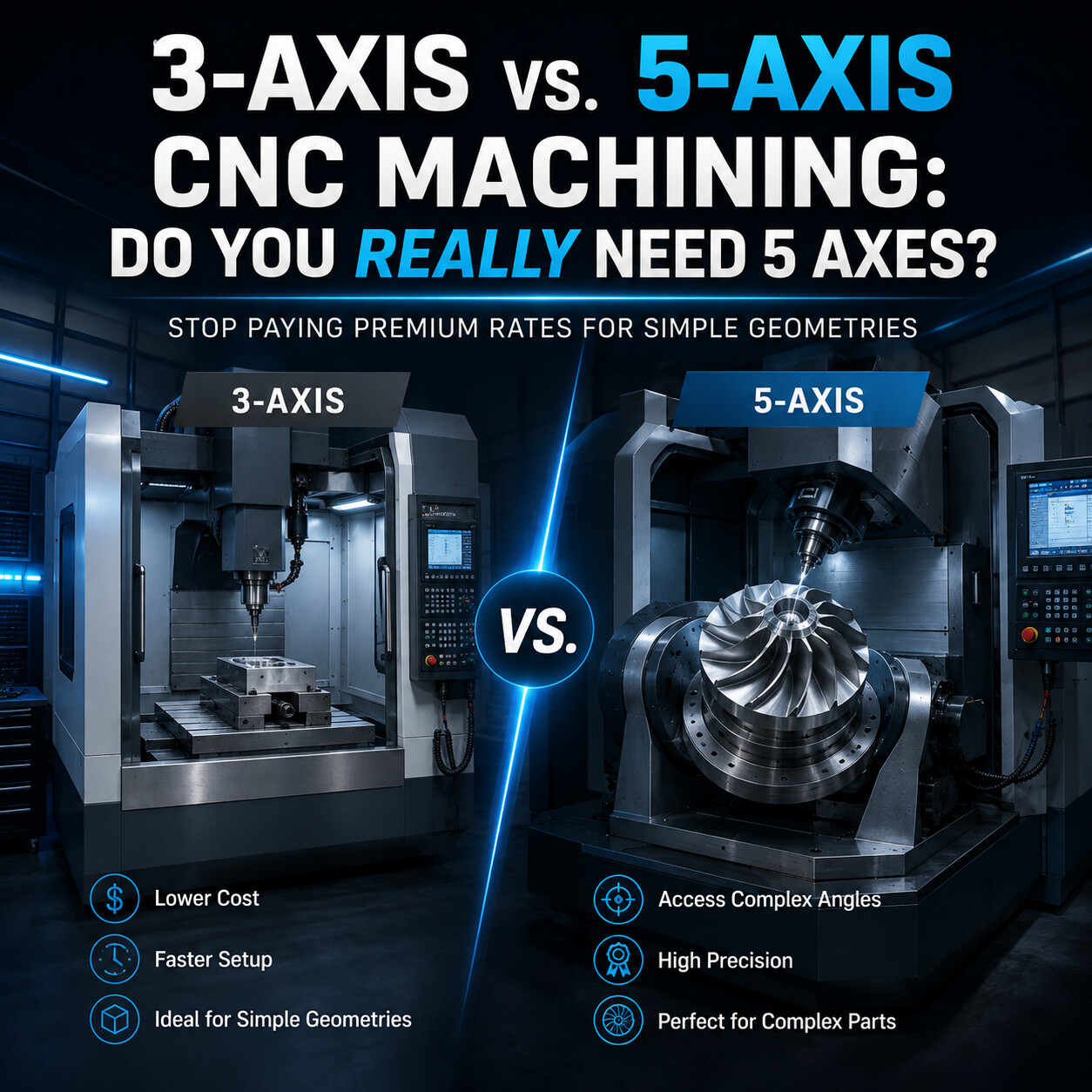
Guide 04: 3-Axis vs. 5-Axis CNC Machining: Do You Really Need 5 Axes?
While 5-axis CNC machining offers unmatched geometric freedom, it comes with a steep price tag. For prismatic components and standard pockets, 3-axis machining delivers identical tolerance compliance at a fraction of the cost. Balancing part complexity against operational expenses prevents unnecessary budget overruns.
Guide 04: 3-Axis vs. 5-Axis CNC Machining: Do You Really Need 5 Axes?
Machining Capability Comparison & Process Selection | Manufacturing Academy
When requesting a CNC machining quote, buyers and engineering teams frequently encounter a critical question: "Should I choose 3-axis or 5-axis machining?" Many assume that 5-axis machining is always superior because it is more technologically advanced. In reality, that is not always true. For many parts, 3-axis machining delivers the exact same quality at a significantly lower cost. Understanding the core technical and economic differences helps you avoid unnecessary expenses while successfully achieving your design goals.
1. Understanding Core Machining Capabilities
CNC machining removes raw material using automated cutting tools. The primary distinction between machine configurations lies in the number of directions (axes) in which the cutting tool or workpiece can move simultaneously.
3-Axis CNC Machining: Moves the cutting tool along three linear axes: X-axis (left and right), Y-axis (front and back), and Z-axis (up and down). The workpiece remains fixed in a single position per setup. This is the most widely used CNC process and is suitable for the majority of machined components.
5-Axis CNC Machining: Adds two rotational axes (typically A and B/C axes), allowing either the cutting tool or the workpiece to tilt and rotate during machining. This enables continuous multi-angle access to complex surfaces without repeatedly repositioning the part.
2. Direct Comparison: 3-Axis vs. 5-Axis CNC
Feature / Metric | 3-Axis CNC Machining | 5-Axis CNC Machining |
Tool Movement | Linear X, Y, Z axes only | Linear X, Y, Z + Rotational A/B/C axes |
Part Setups | Multiple setups required for multi-sided features | Single setup for complex multi-sided geometries |
Tooling & Reach | Standard tooling; longer tools needed for deep features | Shorter, rigid tooling; multi-angle surface access |
Machine Hourly Rate | Lower baseline operational cost | Significantly higher (2.0x – 3.0x standard rate) |
CAM Programming | Standard 2.5D / 3D toolpaths; fast prep time | Complex 5-axis toolpaths; specialized programming |
Ideal Geometry | Prismatic parts, flat surfaces, top-down holes/pockets | Organic 3D curves, angled holes, deep contoured cavities |
3. Application Spectrum: Choosing the Right Machine
When Is 3-Axis the Better Choice?
Many industrial components do not require simultaneous 5-axis machining. If all machining features are accessible from one or two directions, 3-axis machining provides the best balance between quality and cost.
Typical Applications: Mounting plates, brackets, spacers, covers, housing components, manifolds, and standard fixtures.
💡 Cost Tip: If all machining features on a part can be reached with 1 or 2 setups, 3-axis machining will almost always be more cost-effective. Choosing 5-axis in these situations rarely improves final part quality but substantially increases manufacturing unit price.
When Does 5-Axis Make Sense?
5-axis machining is ideal for parts with complex, multi-angled geometries where multiple setups on a 3-axis machine would be impractical or impossible.
Typical Applications: Aerospace components, medical implants, turbine blades, impellers, complex molds, and multi-angle precision manifolds.
4. Cost Factors: Does 5-Axis Always Save Money?
Although 5-axis machining can reduce manual setup time and fixture count for complex parts, several cost drivers increase the overall price for simpler components:
Higher Machine Hourly Rates: 5-axis CNC centers involve substantially higher initial capital investment and maintenance overhead.
Specialized Tooling & Fixturing: Requires high-precision dovetail fixtures or complex pneumatic workholding.
Extended CAM Preparation: Programming, toolpath simulation, and collision verification demand specialized engineering expertise and software.
5. Engineering Evaluation & Process Routing
Professional manufacturers do not automatically route parts to 5-axis machines simply because the equipment exists. Instead, every technical drawing undergoes a thorough DFM evaluation:
Part Geometry: Evaluating feature orientation and tool clearance directions.
Tolerance Requirements: Assessing whether multi-setup repositioning errors exceed tolerance budgets.
Production Quantity: Determining whether dedicated 3-axis fixturing outweighs 5-axis hourly machine rates.
Conclusion & Key Takeaways
3-Axis Dominance: 3-axis machining remains the most economical solution for standard mechanical components.
Targeted 5-Axis Use: 5-axis machining is best reserved for complex geometries and multi-angle feature requirements.
Process Matching: More advanced machining does not inherently mean better value—the right choice depends on part geometry.
Early DFM Review: An experienced manufacturing partner will evaluate your design and recommend the most cost-effective process before production begins.
Next Guide in Series: Guide 05: CNC Machining Tolerances Explained: How Precise Does Your Part Really Need to Be?